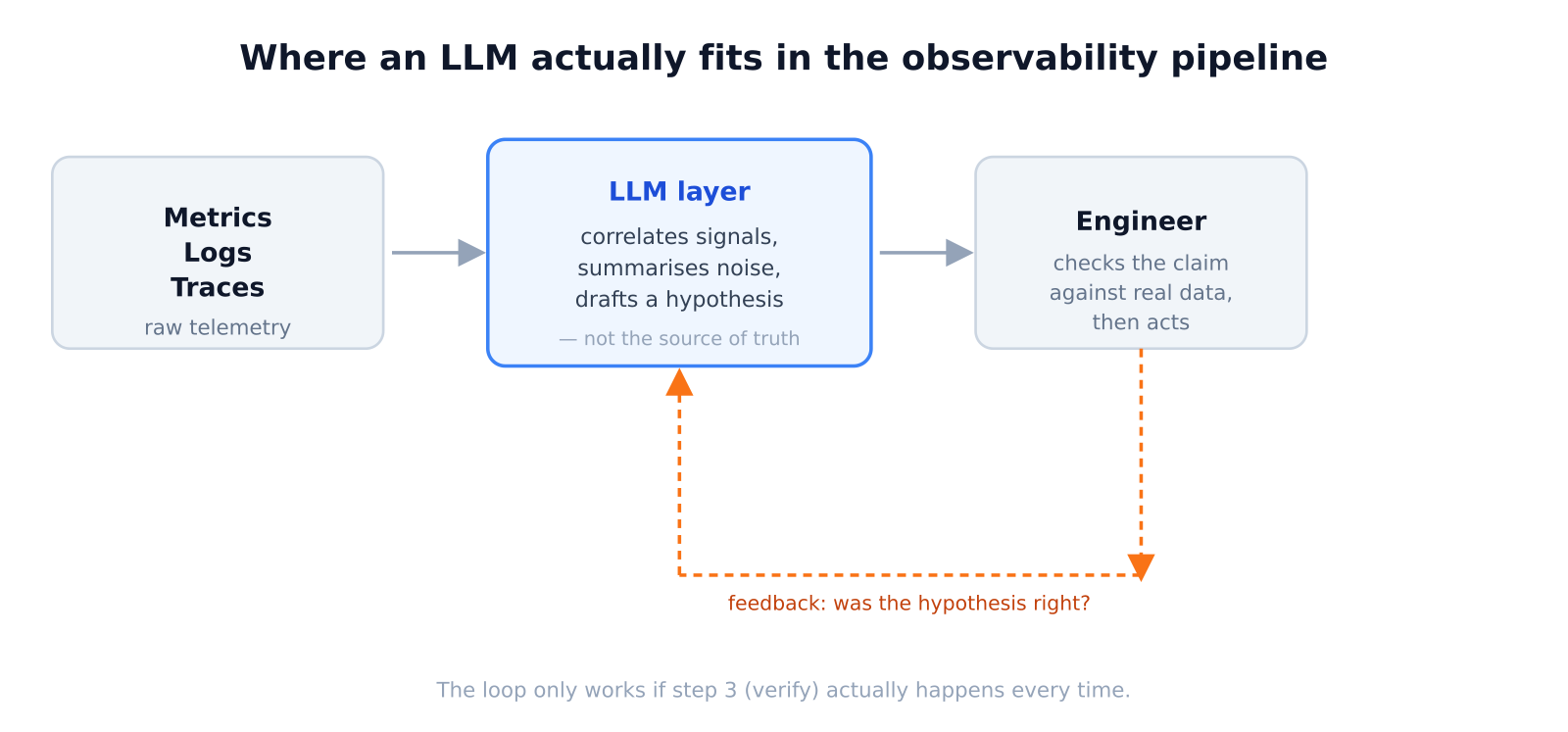
“AI is going to fix observability” is one of those claims that’s simultaneously overhyped and underexplained. Overhyped, because most of the marketing around it implies something close to an autonomous SRE that reads your systems and tells you what’s wrong. Underexplained, because almost nobody selling the idea is specific about which part of the observability workflow the model is actually doing, and which part still needs a human staring at real data. Those are very different claims, and conflating them is where most of the disappointment — and some of the genuine risk — comes from.
This is an attempt to be specific: what LLMs are actually doing inside an observability pipeline right now, the architecture patterns that make it work at all, where it demonstrably helps, and where the failure modes are serious enough that you should be deliberate about how much you trust it.
The five integration patterns that actually exist today
“LLMs for observability” isn’t one thing. In practice it tends to be one or more of these, each with a different risk profile:
- Log summarisation and clustering. Taking thousands of noisy, near-duplicate log lines and reducing them to a handful of representative patterns with counts — “142 occurrences of a connection-reset pattern between 02:14 and 02:19.” This is the lowest-risk, highest-value use case, because it’s compression, not inference.
- Natural-language querying of telemetry. Translating “why did checkout latency spike around 2pm” into an actual query against your metrics/logs backend (PromQL, LogQL, SQL), running it, and returning the result. The model’s job here is translation, not diagnosis — the numbers still come from your real data store.
- Cross-signal correlation. Given a metric anomaly, a set of logs, and a trace, producing a plain-English narrative of what happened and in what order. This is where most of the “AIOps” marketing lives, and where the hallucination risk starts climbing, because the model is now doing inference, not just retrieval.
- Incident timeline and postmortem drafting. Turning a pile of alert history, chat logs, and deploy events into a first-draft written timeline. Genuinely useful, and low-risk, because a human reviews and publishes it — it’s a writing task, not a diagnosis task.
- Remediation suggestion, and occasionally automated remediation. The model recommends (or in more aggressive setups, executes) a fix — restart a service, roll back a deploy, scale a resource. This is the highest-risk pattern by a wide margin, because a wrong action taken automatically is strictly worse than a wrong observation a human catches before acting.
Most of the genuine value sits in the first two. Most of the genuine risk sits in the last two. The middle one — correlation — is where the interesting engineering problem actually is, and it’s worth understanding why it’s hard.
Why you can’t just paste your telemetry into a prompt
A production system on even a modest day can generate more log volume in ten minutes than fits in any model’s context window, and even where it technically fits, stuffing a context window with raw, unfiltered telemetry is expensive, slow, and — critically — dilutes the signal the model needs to reason about. This is the reason every serious implementation of this pattern is built around retrieval, not raw context stuffing.
The pattern, generically, looks like: an anomaly or alert fires with a specific time window and a specific service/host label attached. A retrieval layer pulls only the logs, metrics, and traces matching that window and those labels — often using the same label-based filtering your metrics and logging systems already support, sometimes backed by a vector search over log embeddings for fuzzier matching. That curated, relevant slice is what actually goes into the prompt, not the firehose.
This matters because it’s also the entire answer to the most common criticism of the whole idea: “doesn’t it just hallucinate a cause?” Without retrieval grounding, yes — ask a model “why did my service go down” with no data attached, and it will confidently suggest DNS, an expired cert, or a memory leak, because those are statistically common causes of downtime in its training data, not because it has evidence for your specific incident. With retrieval grounding — the model only reasoning over logs and metrics that are actually from your incident window — the failure mode shifts from “confidently making things up” to “misreading real evidence,” which is a meaningfully smaller and more catchable problem.
The failure modes worth taking seriously
Automation bias. A wrong answer delivered in confident, fluent prose is more dangerous than an obviously broken tool, precisely because fluency reads as competence. Humans are demonstrably worse at catching errors in text that sounds authoritative — this isn’t specific to LLMs, it’s a well-documented bias in how people evaluate automated recommendations generally, and it applies with full force here.
Latency and cost during live incidents. Invoking a large model adds real seconds, sometimes many, at exactly the moment when seconds matter most. For a subset of the workflow (postmortem drafting, log summarisation after the fact) this is irrelevant. For in-the-loop, real-time triage, it’s a genuine design constraint, not a footnote.
Data privacy and compliance. Production logs frequently contain customer data, credentials that leaked into a log line by accident, or internal system details you don’t want sitting in a third-party API’s request history. This is the actual reason a meaningful number of serious deployments of this pattern use self-hosted, open-weight models rather than a hosted API — not performance, but the fact that sensitive telemetry never has to leave the network boundary.
Noise shifted, not removed. If the summaries themselves become long, hedge-everything, low-signal text, you’ve added a new thing to ignore rather than removed an old one. A good implementation is judged by how often engineers actually read the output, not by how sophisticated the pipeline behind it is.
Where the evidence is actually strong, and where it isn’t yet
Strong, low-controversy ground: summarising and clustering large volumes of unstructured text; translating natural language into a query against structured telemetry; drafting a chronological narrative from a set of timestamped events. These are all tasks where the model’s job is compression or translation of information that already exists, verifiably, in your systems.
Genuinely unproven, and worth healthy scepticism toward any vendor claiming otherwise: fully autonomous root-cause diagnosis with no human verification step, and unattended automated remediation for anything beyond a small, well-understood set of known-safe actions. Both require the model to reason correctly about causation in a genuinely novel situation — something outside its training distribution by definition, since every incident is at least somewhat unique to your specific system — with no human check before consequences happen.
A prompt pattern that actually holds up
The single most useful change you can make, if you’re experimenting with this, is to stop asking “what’s wrong” and start asking for ranked hypotheses, each paired with the specific evidence that would confirm or rule it out — grounded explicitly in the retrieved logs and metrics, not general knowledge. Something closer to:
“Here are the logs and metrics from the 10 minutes around this alert. List up to three plausible causes, ranked by likelihood based only on this evidence. For each, state exactly what additional log line or metric value would confirm it, and what would rule it out.”
This reframes the model from an oracle into something closer to a fast, occasionally overconfident colleague whose reasoning you can actually audit line by line — because it has to show its work, and because “confirm or rule out” forces it to commit to falsifiable claims instead of vague plausibility. It doesn’t remove the need to verify. It makes verification fast enough that people will actually do it.
That verification step is the whole point, and it’s not a limitation of the current generation of models — it’s the correct design for a tool that reasons over incomplete information under time pressure, the same way it would be for a human doing the exact same job.