The previous post covered what Zone 2 training actually does physiologically. This one is narrower and more practical: how to build weekly mileage without undoing that work through injury — which, for most recreational runners, is the actual failure mode that ends a training block, not a lack of motivation or a bad training plan on paper.
Same caveat as before: general physiology and training science, not an individualised plan. Injury history, biomechanics, age, and prior training all change what’s appropriate for a specific person.
The 10% rule is popular, and weaker than its reputation
The “never increase weekly mileage by more than 10%” guideline is close to universal in running advice, and it’s worth knowing it isn’t as strongly evidenced as its ubiquity suggests. A 2012 prospective study by Nielsen and colleagues, tracking novice runners, is frequently cited in this context — and one of its findings actually complicates the simple version of the rule: rapid, sudden increases in weekly distance were associated with higher injury rates, but a flat, universal 10%-per-week ceiling doesn’t fully capture what the data show, because injury risk isn’t just a function of last week versus this week. It’s a function of how prepared the body already is for the load being asked of it.
That reframing — from a fixed weekly percentage to a question of overall preparedness — is where more recent sports science has actually moved, and it’s a more useful lens even though it’s less quotable.
Acute:chronic workload ratio — a better model
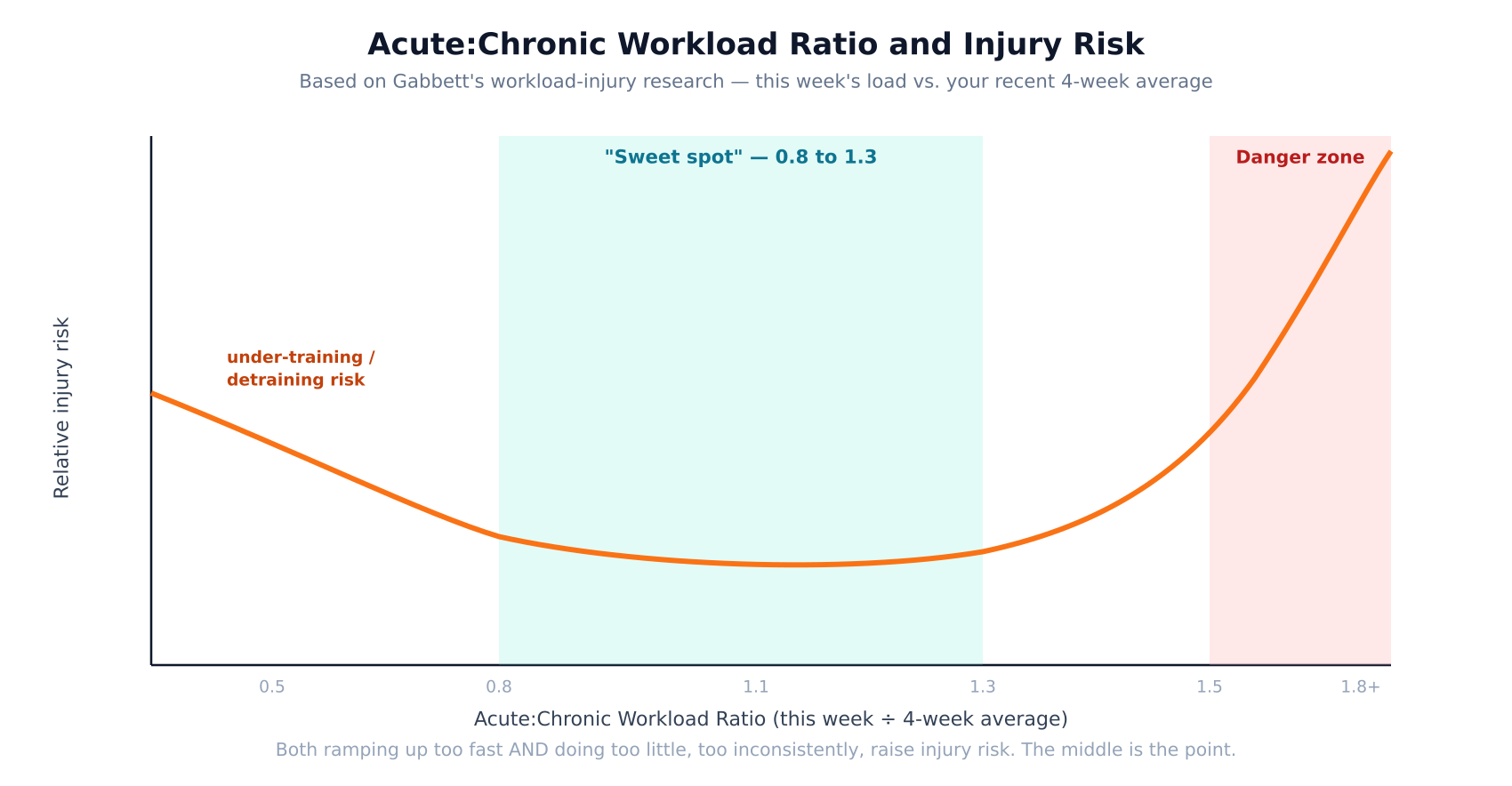
Tim Gabbett’s workload research, originally developed in elite team sports, models injury risk as a function of the ratio between acute load (typically the last 7 days) and chronic load (typically a rolling 28-day average) — the acute:chronic workload ratio, or ACWR. The finding, replicated across a range of sports since, is a “sweet spot” roughly between 0.8 and 1.3: load that’s meaningfully higher than your recent average, but not dramatically so. Ratios climbing above roughly 1.5 are consistently associated with sharply increased injury risk in this research.
The equally important, less-discussed half of this curve: risk also rises at the low end. Someone training inconsistently — big weeks followed by unplanned rest, then another big week — never builds a stable chronic baseline, so any single week of real effort looks disproportionately large by comparison. Consistency itself is protective, independent of how large the absolute mileage is. This is the actual mechanism behind “couch to 10K in three weeks” injuries: the acute load is enormous relative to a chronic load of essentially zero.
Why bone and tendon are the actual limiter, not the heart
The mechanism worth understanding is that cardiovascular fitness improves faster than the musculoskeletal system can adapt to the loading that fitness now allows. Bone remodels according to Wolff’s Law — laying down more density along the lines of mechanical stress it’s regularly exposed to — but this is a slow cellular process, measured in months, compared to the weeks it takes cardiovascular capacity to noticeably improve. Tendon adaptation, studied extensively by researchers like Michael Kjaer, shows a similar pattern: collagen synthesis in load-bearing tendon rises for around 24–72 hours after a loading session, but full structural remodelling of the tissue takes considerably longer.
Practically, this means the thing that makes a rapid mileage jump feel fine — you’re not out of breath, your legs feel okay the next day — is exactly the thing that makes it dangerous. Cardiovascular and even muscular fatigue signals recover quickly enough to mask the fact that bone and tendon haven’t caught up yet, and stress reactions, stress fractures, and tendinopathies are the direct downstream result of loading tissue faster than it can remodel to handle it.
Why building the volume in Zone 2 specifically matters here
This is where the two topics connect directly. Adding mileage at a genuinely easy, Zone 2 effort accomplishes the volume increase while changing only one training variable at a time — total distance — rather than two simultaneously (distance and intensity). A core, well-supported principle across strength and endurance training alike is that stacking multiple significant increases in load at once compounds risk in a way that isn’t simply additive. Slower Zone 2 pace also means a lower rate of force loading per stride at any given cadence, which matters directly for exactly the bone and tendon adaptation timelines described above — it’s a way to add the stimulus that builds aerobic capacity while keeping the mechanical loading rate on connective tissue comparatively modest while it catches up.
This is also the physiological argument for not “just running the extra miles a bit faster to save time” — doing so reintroduces exactly the compounded acute load the ACWR research flags as the highest-risk pattern, at precisely the point in a training cycle when the musculoskeletal system has the least accumulated preparation to handle it.
A concrete build pattern
The pattern that reflects both the ACWR research and standard periodization practice: three weeks of gradual mileage increase, followed by a deliberate cutback week — typically 20–30% below the peak of the preceding build — before continuing the climb. The cutback isn’t wasted time; it’s what allows chronic load to actually catch up with the recent acute increases, resetting the ratio back toward the sweet spot before the next push.
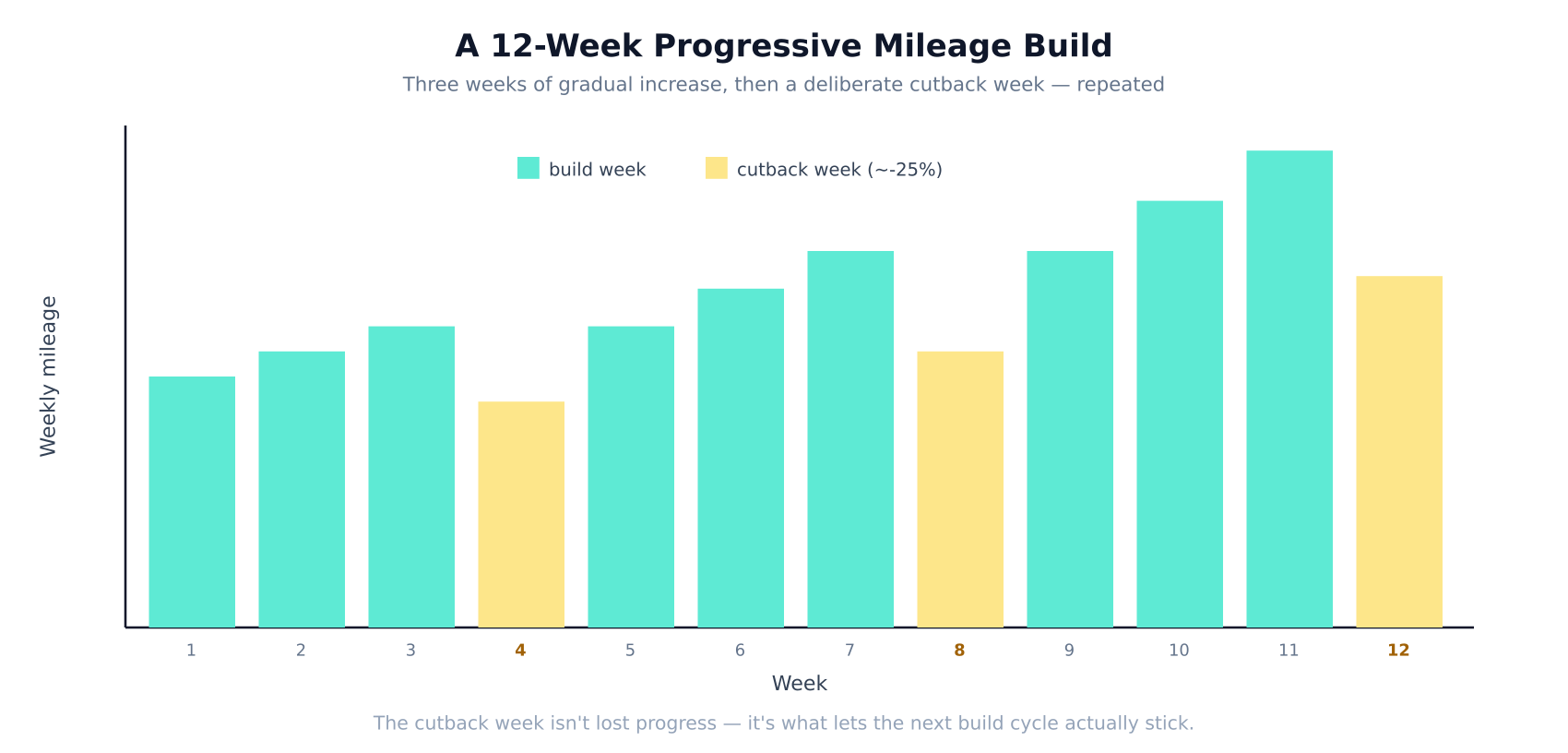
Within each build week, the increase itself should stay gradual and should come overwhelmingly from Zone 2 volume rather than added intensity, for the reasons above. And the whole pattern should be treated as a guideline to individualise against, not a rigid prescription — someone returning from injury, or with a lower baseline chronic load, needs a flatter ramp and longer cutback weeks than someone with years of consistent volume behind them; the underlying ACWR logic is the same, but the acceptable slope of the curve genuinely differs by individual training history.
What actually predicts trouble ahead of time
A handful of signals are worth monitoring specifically because they tend to precede a bone stress or tendon injury by days to weeks, giving a genuine window to back off before it becomes a forced one: a specific, localised ache that’s present at the start of a run and doesn’t fade after warming up (as opposed to generalised, diffuse fatigue, which usually does fade); resting heart rate elevated several beats above your normal baseline for multiple consecutive mornings; and sleep quality or mood noticeably declining without an obvious external cause. None of these are dramatic on their own, which is exactly why they’re worth deliberately tracking rather than relying on noticing them incidentally.
The uncomfortable truth underlying all of this is that the injuries which end training blocks are rarely caused by a single bad run. They’re caused by a training load curve that outran the slowest-adapting tissue in the chain, for long enough that it eventually said so.